Implementing
After making my project plan, I have started to get to work on the organising aspect of the fashion show. The first step was to help to organise and finalise the list of who was planning on making a collection to be able to do an individual catwalk in contribution to the show. In this stage, I also asked to have my own individual catwalk to be able to put forward my collection to be shown during the event. I had to submit my designs and drawings, along with my title of the collection, concepts and annotations to Mrs Gilbert (textiles teacher). Once this was approved, I was able to start thinking more on choices of fabric to use and further designing. The list for the other catwalks were also submitted and written up into a list. In the end there were about seven catwalks for the show.
After the individual catwalk organisers were finalised and decided, it was time for the model casting. The model casting is usually held in a lunchtime slot where potential models from all year groups in the school are invited and are selected by both Mrs Gilbert and the catwalk organisers. This year, it is also going to be held in a lunchtime slot in the textiles art room space. This event was publicised in school assemblies to all year groups and also a message was sent out through the school office to both parents and students to make everyone aware that this was happening. The school office was asked by us (the fashion show committee) if they could pass on the message and produce a message to be sent out to both parents and students.
After the event was publicised and the message was sent out by the school office administrator team, the team decided to pass out one final message for a final reminder on the day of the auditions just to remind everyone who wanted to audition to attend that lunchtime.
Catwalk organisers and fashion show committee were asked by Mrs Gilbert to get there a bit earlier just to discuss and confirm how many models were needed for each walk and what "looks" organisers were looking for in their collection and to chose models that went accordingly. The models then arrived around 5-10 minutes later and were signed up and registered to see who turned up and so that we had all their names and form classes listed in case catwalk organisers would want to get in contact with them for them to model for their collection. After the registration aspect was covered, the potential models took it in turns to walk up and down in front of everyone for catwalk organisers to see what their "look" was and what walk they had. Then catwalk organisers wrote several names down of who they wanted their models to be and handed this list in. After all those who auditioned had presented their walk, they were all told that we would make final decisions regarding who was chosen and for what walk, and then put it onto a list printed and pinned on to the door of the textiles room. All the designers/catwalk organisers had given their lists in on who they would want to model for the collections, so it was time to draw up the drafts on who was modelling for who and who unfortunately was not going to be given a role to model. There were so many students who auditioned to model for the fashion show so it was impossible to be able to say yes to everyone and we knew that a lot of people would be disappointed if they did not get a chance to model, so we did try to strategise who we would accept to model and who we were to say no to. The strategy was to take in as many year 7s as possible as they would be the ones in general to be more likely to be disheartened and they are brand new to the senior school so it would be nice to include as many of them as possible in this event which would also be very new to them too. The plan was also to favour those students who had never modelled for the fashion show before as it would be unfair to always pick the same models over and over again every year. Of course there are students modelling this year who have done it before, but it is only fair to branch out from previous models and give new people, new opportunities. This list was then finalised with a few drafts needed to work out the final number of models needed for each designer. As a collective, most designers needed around four to six models as that was the number of garments they were going to make in their collections.
We then put up the final list of models on to the door of the textiles room for all students to come see who made the cut. Of course there were such a vast number of students who came to model so a lot of them had to be declined and said no to. This was probably the hardest part as everyone seemed so excited and passionate about modelling for the fashion show. We did add a small message on top of the model list to congratulate everyone and to say that if we could, we would have chosen everyone and accepted everyone to model, but due to the restricted numbers of models needed for a certain amount of catwalks, we were not able to say yes to everyone.
We also added the designers' emails on to the list of models so that the models could be proactive themselves and get in touch with the designer that they were modelling for and let them know their own contact information so that the designers could get in contact with them. The designers were then responsible to carry out fittings to get the measurements of the models so that they could start making their collections for the show.
The next thing that needed to be done was to book and confirm dates and times. The initial idea was to do the last Friday after school in the evening for the show, however it came to us that it was highly likely that at least a few students would have plans to go on holiday and may have gotten flights and started travelling after school or even missing that day of school. So then the Wednesday on that same week was considered. That way it would be a date where most would be able to do and be in school for. Then the issue of timing had to be discussed and was planned to start at 7pm on the Wednesday till 8:30pm due to parents having to come from work and models needing to rehearse and get their hair and makeup done. So 7pm was an ideal time as a lot of the working adults in the audience would have to leave work and still have to commute to the school to watch the show. The ending time was decided to be 8:30pm meaning that the show would last an hour and a half so that there was time for the hosts to give their mini speeches and all the catwalks to show their walk and the performers to have their time to perform too. If it were to end earlier that would be better than over running the show, and giving the audience a false ending time just in case they were to have plans for example after the show or to make any arrangements. This information was then passed to the senior leadership team of the school for them to discuss and approve (or decline) the date and timings. This was approved very shortly after giving them the information and then we had to pass this on to the school office administration team so that they could input this into the school system and to show up on the school calendar and important event dates. The rehearsal times and dates also had to be decided, so it was decided that the Friday before the fashion show event, there would be a rehearsal from 4pm till 6pm, another rehearsal on the next day on Saturday at 10pm till about 12/1pm, then two more rehearsals on both Monday and Tuesday from 4pm till 6pm, and finally a last rehearsal before the show on Wednesday. The first rehearsal is meant to introduce everyone into the real running of the show and give a feeling of the next couple of days. This is also to see how everyones walks fit in and how well choreographed and rehearsed everyones walks are. The running order will need to be decided before this so that rehearsals would run as if it was the real event. This first rehearsal is also to see which catwalks need more individual rehearsals as all the catwalks will show their walks off and those that were lacking will go out of the theatre and into another location and rehearse individually their own walk and then come back to show for approval. The Saturday rehearsal is mainly a technical rehearsal, because everyone should know roughly the drift and routine that will happen, so it is then time for the technician team to attend the rehearsal to experiment with lights and music and the whole technical side of the show. This is mainly a rehearsal to see how the tech ties in with the show and to make sure that it is all working under control and working out for both sides of the show. Then there is two dress and technical rehearsals on Monday and Tuesday to make sure that there are no problems with the collections themselves as for example, someone might have ripped a garment trying to get it on to model for the way and that would give the designer two whole days to fix the issue rather than one night if it were only to be a dress rehearsal on the Tuesday after school. The final rehearsal on the day of the show is just to give everyone a feel for exactly what is to come and to give a reminder and recap to everyone modelling so that everyone knows what is going on.
After sorting out the dates and times, it was then time to book the theatre itself, which was relatively straight forward, all that needed to be done was to input the date and time that the theatre was being used into the school system to let anyone else know that it was being in use on those dates and times. The theatre was booked for a total of five slots for both rehearsals and for the real event so that the location was definitely secured.
After all this was organised, we then arranged a meeting closer to the date for all catwalk organisers to attend as there were two more things that they (and I) had to work on as the designers of our own walks. The aim of this meeting was to set various deadlines and to see how everyone was coming along with their work for the show. The two things that the designers needed to work on were a small description of their walks to then send to the hosts so that they could learn prior to the show so that they could recite and tell the audience exactly what the concept of each walk was and all the ideas and messages that the garments were trying to communicate. This was the first thing needed from catwalk organisers to give in which there was a week to do that small blurb about their collections before needing to hand into the hosts so that they could got on with learning. The next thing to set the designers to work towards was for them to create a video to go in the background of their catwalks. The point of the video is for there to be several clips edited in the video to communicate the theme and concept of each collection. Each individual catwalk was given about 2 minutes 30 to 3 minutes for the amount that they should choreograph the walk for and for the duration of their whole walks in general. The video had to run for as long as the choreography and the walk went on for, so the maximum duration limit was three minutes for each walk and video. The video is meant to run in the background on the screen whilst each walk is going on. The video is meant to be filmed and made, as well as edited by each designer which was the second thing that they had to work on, which the deadline of giving in and submitting was two weeks after this meeting so that the tech team could watch the videos and figure out what lighting would go best in each individual catwalk.
The next steps now after booking everything and organising the majority of everything needed in preparation for the event, were to promote the event itself and to organise the selling of the tickets. Therefore, the promoting and advertising needed to be organised for the show. The initial title for all the walks was "Deconstruction", this title was decided at the very start of the show in a brief meeting with the art department to choose what umbrella term to fit the show under. After the title was given out, all designers would interpret the title as they will and morph their ideas to fit under this broad title. Therefore in terms of the publicising of the event aspect, we decided that a poster had to be designed as it was the most effective way of promoting this event as it would be put on almost every, if not all rooms and corridors of the school. The poster had to include the title, date of the event, timing of the event and location. Aside from these key pieces of information, there was not much else that needed to be added aside from images and collages to make it aesthetic and to draw attention from people walking by the posters. The poster was designed and drawn up with a rough idea of what was going to be done, but from there it was mainly experimentation on working on the poster and producing several drafts to see how the poster evolved and got better, till the final design was chosen. With the title "Deconstruction", the main idea for the poster was to look at deconstruction in an out of the box concept rather than looking at it as deconstructions of buildings for example which is the most obvious example. The poster was designed to look more at the deconstruction and construction of various elements such as in society and in cultures. All these images were collated together into the poster as a whole and then the key information was added on top of the poster along with the title. This was then printed out and hung up around the school for everyone to see. The tickets were also very similar to the posters so designing that was fairly straightforward as the tickets were basically the smaller version of the posters except they were printed on to A5 card instead of A3 paper. These tickets were then printed out and handed to the office for the selling process.
More advertising of the event included messages in whole school assemblies and in form times before lessons. There was also a letter sent out for those students involved in the fashion show with all the dates and timings of every rehearsal and for the actual event and all the other information needed so that everyone is familiar and knows what will happen at the event and in preparation for the event. There was also a message sent out by the school office administration team, sent out to parents, students and staff regarding the event and ticket buying to remind everyone to purchase the tickets.
Timeline of events/meetings and key deadlines:
| Team meeting to discuss the overall plan of the event and delegate tasks. Eve was chosen to design the poster for the show and advertising. Theatre was officially booked. Rehearsal dates and times were discussed and date of show was discussed. I, Ana and Eve, alongside Mrs Gilbert attended this meeting. (From here everything else was emailed back and forth to arrange and organise the event.) | Monday 3rd December 2019. |
| Deadline for designers to sign up to put forward their collections for the fashion show event. | Wednesday 9th January 2019. |
| Deadline for designers to present their designs and ideas for their collections for approval. | Thursday 10th January 2019. |
| Open casting for finding models for the designers. This casting will be happening in the textiles room at 1:10pm at lunchtime. | Friday 11th January 2019. |
| Models are confirmed and chosen by this deadline and the final list goes up on display on the door of the textiles room for everyone who auditioned to come check if they made it and secured themselves a spot. | Monday 14th January 2019. |
| Whole team meeting of all designers at 10:35am (break time) in the textiles art room to discuss more deadlines that need to be met and to discuss collection videos and further details. Members who attended meeting are as follows: Myself, Ana, Mabel, members of fashion show society, Honor, Alex and Eve, alongside Mrs Gilbert. | Friday 18th January 2019. |
| Deadline for choosing and selecting the hosts of the show. There will need to be two main hosts. Two hosts chosen were Poppy and Olivia. | Monday 21st January 2019. |
| Deadline for submitting a short paragraph outlining the story and inspiration behind the designer's collections. These paragraphs might include references to imagery that designers have worked from, social issues you are addressing or it might describe the colour palette, textures/prints and forms that designers have explored. This will need to be sent directly to the two hosts of the show so that they can personally work on it and learn the paragraphs in preparation for hosting the show. | Friday 25th January 2019. |
| Deadline for designers to be submitting their videos of their collections. There will be a folder entitled "VIDEOS' which can be found on the school's pupil shared area, in the sixth form section and then in the fashion show folder so that it is easy accessible by all; for designers to save their videos and for the committee and the art department themselves to check that all the videos have been submitted and to check through them. These videos should be in the region of two minutes and thirty seconds to three minutes long. It will be very important to meet this deadline as the main technician (staff) Mr Arrowsmith will have a lot of work to do in regards to organising and programming the lights alongside the video. It was then part of Eve's role to go to Mr Arrowsmith and check that he had received all that was needed and discuss the plans for lighting. | Thursday 31st January 2019. |
| Individual catwalks will have to come to the art textiles room to show their choreography in advance to the main rehearsals in the theatre. | Week beginning 28th January 2019. |
| First run through rehearsal of all catwalks, there will be no need for performers to attend, and neither for the hair and makeup team. The technician team will have to attend to start to programme and experiment with lighting. (4pm-6pm) | Friday 8th February 2019. |
| Date of the technical rehearsal needed to make sure that the technician team know what they are doing and for them to practice with lighting etc. (10am-1pm) | Saturday 9th February 2019. |
| This will be the date for the next whole team rehearsal, which will also be another technical rehearsal and the first dress rehearsal. This is a very key rehearsal as it shows the outfits that the designers have created and it also makes the designers aware if they have to make any last minute alterations. (4pm-6pm) Ana will then order the pizzas (20 margarita pizzas, and 1 gluten free pizza, and also 1 dairy free pizza). | Monday 11th February 2019. |
| This will be another technical and dress rehearsal but this time it will be for everyone involved with the show, including the hair and makeup team so that they can go round to the designers and double check the looks that they are going for with their collections. (4pm-6pm) Eve and Ana will then go to buy and collect the flowers for Mrs Gilbert to thank her for all the help she has given in contribution to the show and helping the designers. | Tuesday 12th February 2019. |
| This will be the date for the real event happening and there will of course be rehearsals before the show starts. Everyone will arrive at the school theatre for rehearsals at 3:45pm to have a full run through of the show, before getting ready, eating dinner and before the actual show starts. The show will finish at around 8:30pm. | Wednesday 13th February 2019. |
From the 30th of January, this is the key deadline for advertising to be planned and approved by the committee. As mentioned before, the advertising will consist of making posters to be hung up around the school, aside from this there will be a message sent out to all students, staff and parents through the school office. The tickets for the show will also have to be designed and printed. This will be on sale in the office from the 5th of February latest. This will just over a week of sales of tickets to made, there will also be an option to buy on the night of the show on the door before entering the event.
The poster has been designed around the title "(De)construct" so has images of fabric, different colours and the deconstruction of clothes. As already mentioned, this poster has been designed around the idea of deconstruction in textiles approaches and in fashion terms. The tickets will also be a replica but a smaller card version of the poster. A photo of the ticket and poster will be uploaded below. There will also be a programme made for the audience members to follow through the show, and know who is coming up and when they are coming up. It also gives them an idea of what the structure of the whole show is and also gives the student credit for their work.
Photo of the fashion show ticket and the fashion show poster:
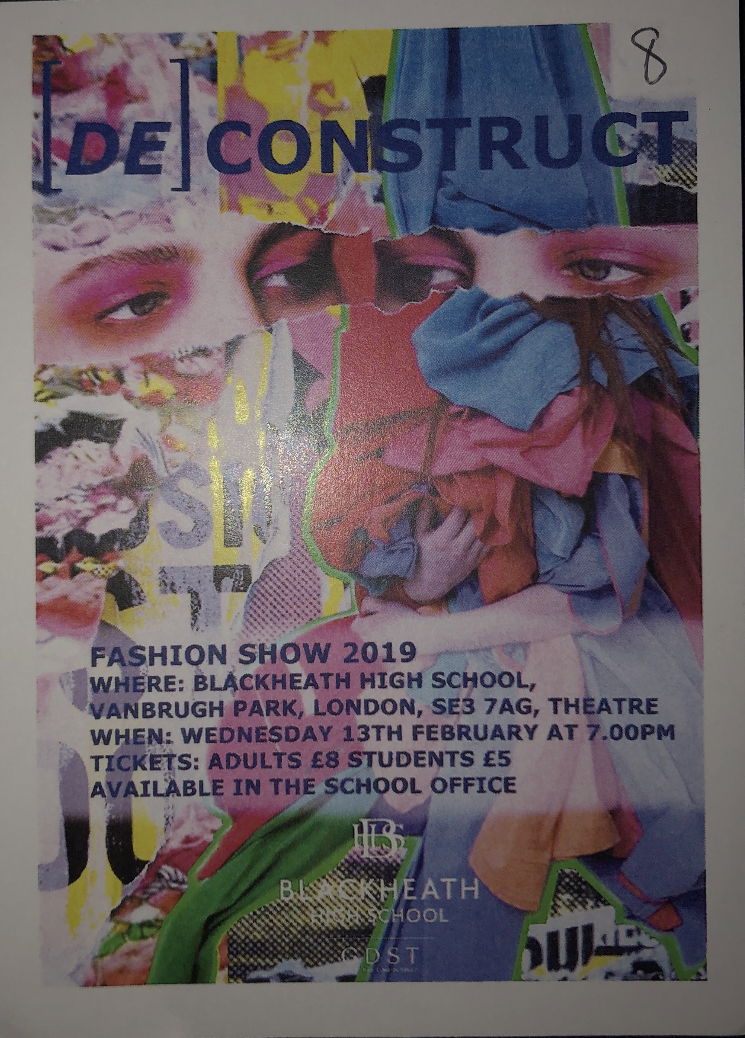
This is an image of the fashion show ticket which is printed on to A5 card so that it is easy to carry and accessible to all guests and audience members of the fashion show. The fashion show poster is exactly the same but printed off on to A3 sheets of paper to be hung around the school. It has the title of "(De)construct" on the top of the ticket to remind the audience of what the concept of the show is. It also has the title of: Fashion Show 2019, to have a copy of this ticket in the school records and remember this particular year of the fashion show. There is also a `'where" and "when" section to let the audience members know when to arrive and where to actually arrive for the show. There is also concession prices on the design to let the audience members know exactly how much each ticket is. The pricing model is £8 for adults and £5 for students. These prices have been decided so that enough money is raising to cover all the costs of the show and also to fundraise for the sixth form ball to happen for the sixth formers after their exams. There is also a little note at the end to let people know where to buy the tickets from. On the tickets, there is also a small number on the top right corner, to let us (the fashion show committee) and the school office know exactly how many are sold.
Screenshot of the message from the school office to promote event:
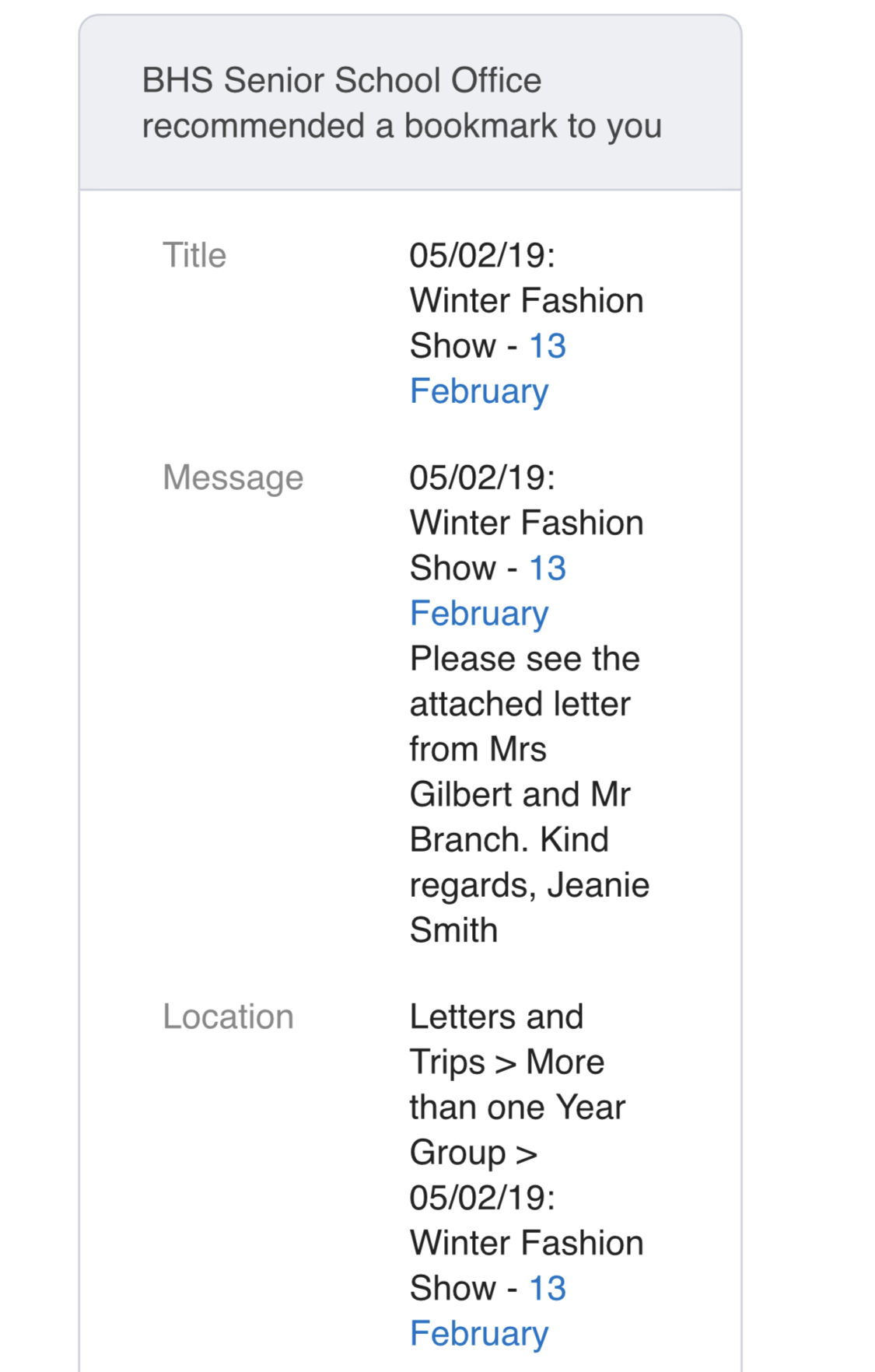
This is a screenshot from the message sent out to all parents, students and staff about the fashion show event. This was the next step in promoting the show. This message was sent out through the school communication system. The message is split into three subcategories for a clearer message. The first subtitle is the "Title", then it says; "05/02/19: Winter Fashion Show - 13 February." This is to show that a fashion show is happening and what the date of the event will be. This will let parents, staff and students know when the show is to hopefully save the date and to remember to buy tickets. The next subcategory title is: "Message", this then goes on to say; "Winter fashion show - 13 February. Please see the attached letter from Mrs Gilbert and Mr Branch. Kind regards, Jeanie Smith." (Jeanie Smith is the school's office lady who sent out this message for the potential audience members to see.) There is also an attached link to a letter promoting the show and letting parents know what the responsibilities of their children are, who are involved in the show, as that is what the letter mainly covers. The letter also covers when the show starts and the date of the show, as well as the location of the show. This will let parents know to attend the event as of course, students and staff are in school every day and will see the posters hanging around school but the majority of parents are not in school grounds so will not have seen these posters. The next title is "Location", which tells parents, staff and students where to access this letter from.
To evaluate my leadership, I will self assess at the very end of the event, so I will self assess how I think I managed the project planning, the rehearsals and the execution of the event. I will also ask for feedback from the other participants, including those on the fashion show committee team. I will make a survey on SurveyMonkey.com and will be asking for participants to go on the website through the link I give them and just to fill out the survey. I will make sure to have as many participants answering from different sections of the show. It is better to have participants answering anonymously through this online survey as some might be "too nice" if I asked them to complete a survey in person. And I do want participants to give me 100% honest feedback and to say a critique on what I could have done better in their opinion.
As mentioned, the plans for the public showing is for audience members to arrive at 7pm and to get given a programme booklet with all the details of the structure of the event. Then the hosts will introduce the show, catwalks will be shown, performers will perform their individual performances, there will be a finale of all the catwalks and speeches given. Then there will be refreshments and nibbles offered in another of the rooms in the school premises.
Consideration of Legislation:
It is obligatory by law for the hosts to state and tell the audience where the fire exits are and what the fire safety protocol is before the event starts. This important piece of information will be incorporated into the speech of the hosts. Another important piece of legislation that needs to be incorporated in the show is that a certain number of audience members by law are allowed to attend. There is only about a maximum of 200-250 external audience members allowed to attend because otherwise the venue becomes too crowded and is a fire and health and safety hazard, as in the event of a fire, there would be too many people to evacuate at one time and would cause a delay in evacuation.
